The Levothyroxine Information Gap
Levothyroxine is one of the most-prescribed medicines in the world. It is also a narrow-window drug whose label tells patients only part of what they need to know. This section is about the gap between what the evidence says and what patients are told — and about two simple options patients are rarely offered.
Start here
I take levothyroxine and still feel unwell
Read the refractory patient, then timing and Questions to ask your clinician.
I want the evidence, not the story
Start with the drug, the antidepressant data and the sources.
I am a clinician or researcher
Go to the combination trials, the preference gap and What would settle it.
Switching to bedtime dosing solved three years and nine months of hypothyroidism.
My laboratory results document the change.
Joshua Davis · my experience and laboratory record
For three years and nine months, my hypothyroidism remained unresolved. Switching my daily levothyroxine to bedtime dosing solved it. I have laboratory evidence documenting the change.
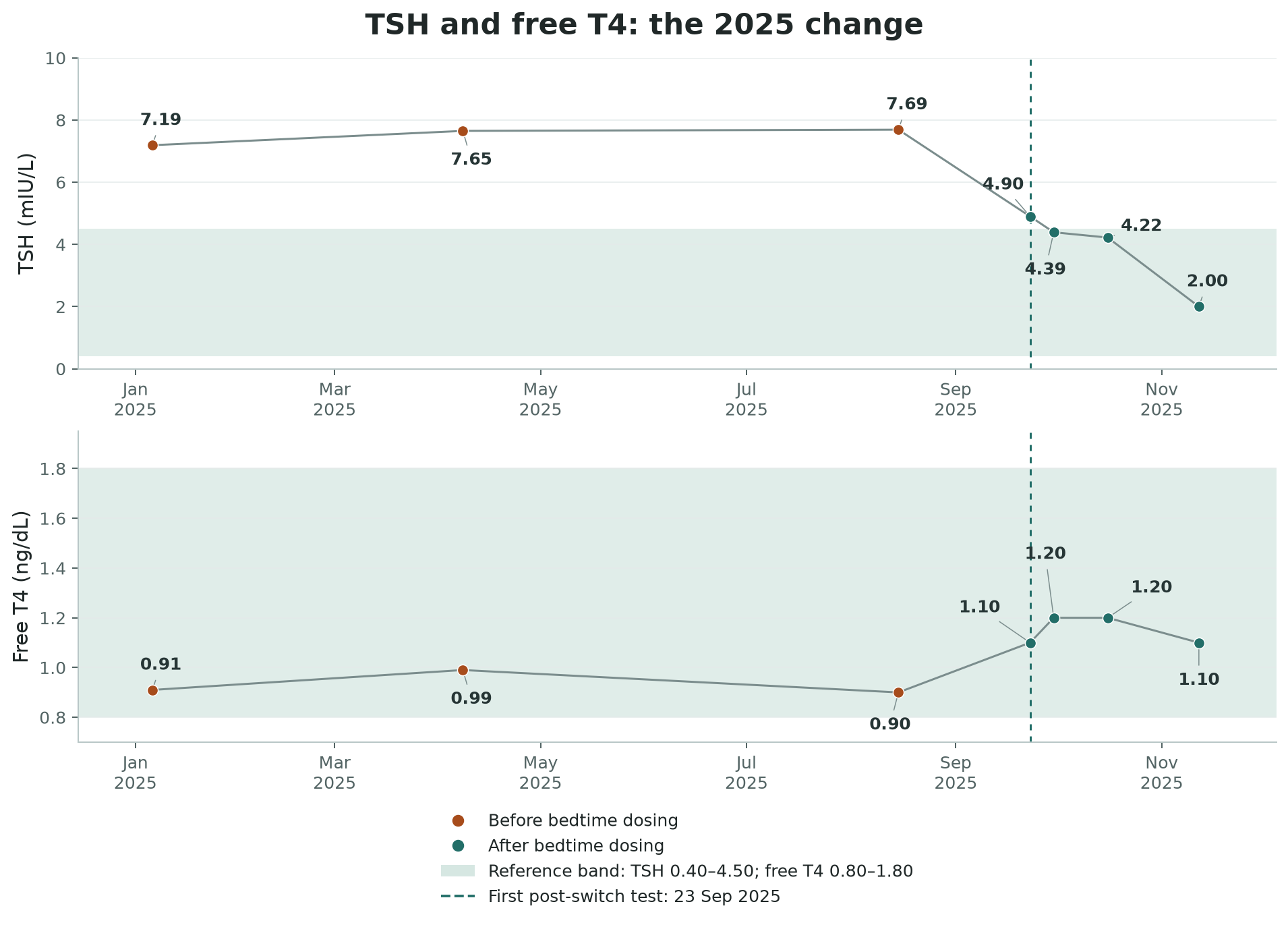
Before the switch, my TSH remained above the laboratory reference range: 7.19 in January 2025, 7.65 in April and 7.69 in August. After switching to bedtime dosing, it fell to 4.90 on 23 September, 4.39 on 30 September, 4.22 on 16 October and 2.00 in the result reported on 13 November (sample collected 12 November).
My laboratory evidence: TSH and free T4
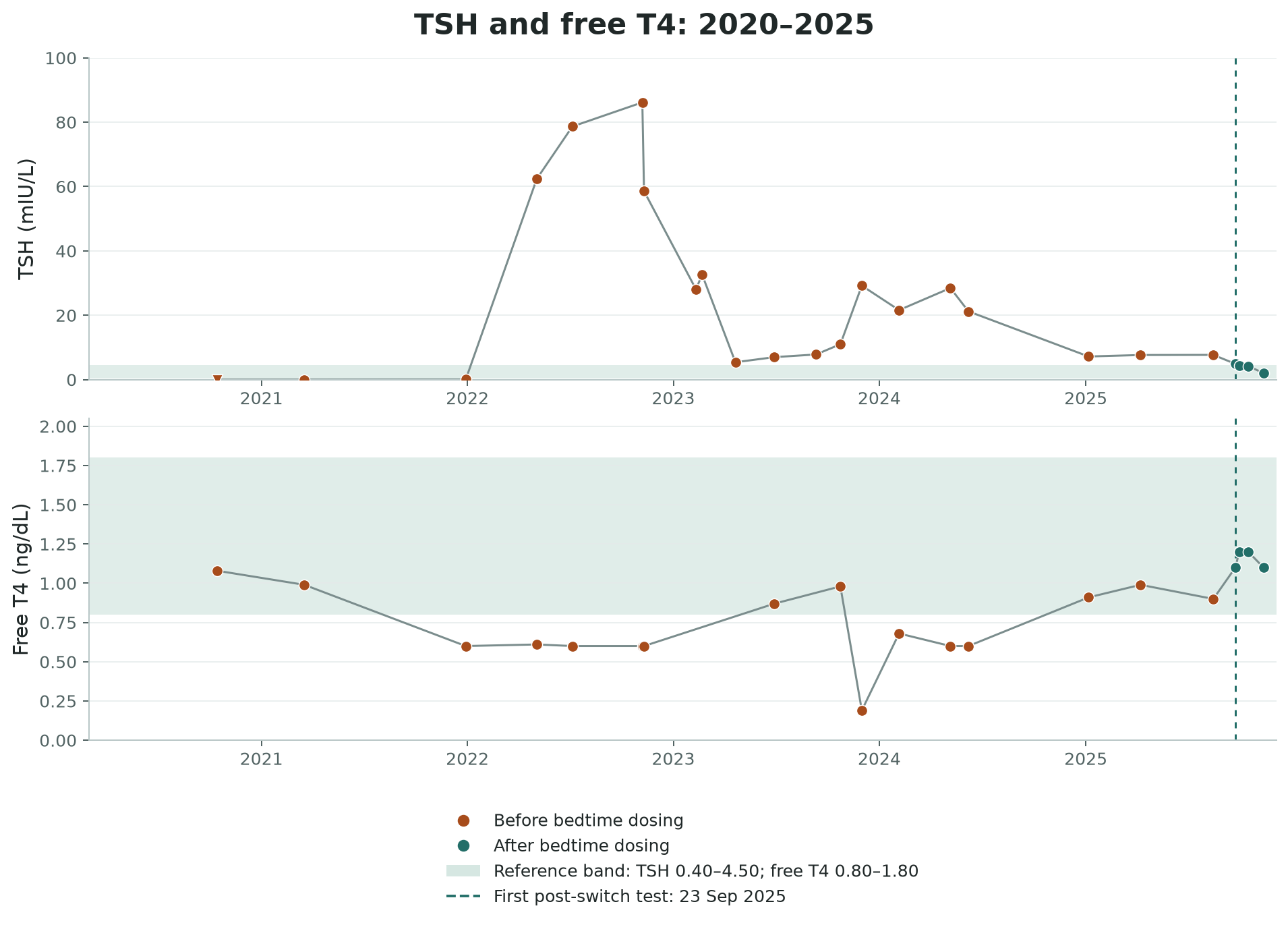
My TSH and free-T4 results since March 2020 are shown below, with a closer view of 2025.
The shaded bands show TSH 0.40–4.50 mIU/L and free T4 0.80–1.80 ng/dL. Each laboratory’s reported range is retained in the downloadable CSV. The September 2025 marker identifies the first blood draw annotated as after one night of bedtime dosing.


Download the lab data — CSV, 4 KB, 44 results with dates, units, reference intervals and sources. JSON data — 9 KB, the same record with notes.
“Switching to bedtime dosing solved three years and nine months of hypothyroidism.”
This is my experience and my laboratory record. It is why I care about the information patients receive about levothyroxine. The rest of this page examines the published evidence on timing, persistent symptoms and supervised treatment options.
The narrow-window drug
Levothyroxine has a narrow therapeutic index, and its absorption is unusually easy to disrupt. That is not a patient’s imagination; it is in the label, in the guidelines, and in the absorption literature.
Product labelling; ETA 2025; ATA 2014.
Levothyroxine is not a drug you can take casually with breakfast. It is a narrow-therapeutic-index medicine: small differences in the amount absorbed can move the body between under- and over-replacement. The label says so directly:
“SYNTHROID has a narrow therapeutic index. Over- or undertreatment with SYNTHROID may have negative effects on growth and development, cardiovascular function, bone metabolism, reproductive function, cognitive function, emotional state, gastrointestinal function, and glucose and lipid metabolism.”
The same warning appears across the class. And the absorption is not merely “take it on an empty stomach” simple. The 2025 European Thyroid Association guidance summarises the physiology:
“The optimal absorption of LT4 is under fasting conditions, with 62–82% of the dose absorbed during the first 3 h after ingestion… Some types of foods and dietary supplements have been reported to reduce LT4 absorption, including soy, coffee, calcium, and grapefruit.”
That list is the practical core. Coffee, calcium, iron, soy, grapefruit, fibre, proton-pump inhibitors, antacids, bile-acid sequestrants and a long list of other medicines all change how much levothyroxine reaches the blood. The ATA’s 2014 guideline noted the same, including a case series of patients whose TSH rose when they took their tablet with espresso coffee — and, remarkably, that the effect of a multivitamin “does not appear to have been studied”, even though its calcium and ferrous content would be expected to impair absorption.
Malabsorption is real. So is pseudomalabsorption.
Patients who remain hypothyroid on a high dose are often assumed to be non-adherent. Sometimes they are. But the two possibilities are distinguishable: a levothyroxine absorption test can separate true malabsorption from “pseudomalabsorption” — intentional or unintentional non-adherence — and the ETA guidance recommends the test when clinically appropriate after other causes have been excluded. The existence of the test matters because it tells patients something the label does not: your experience of not absorbing the drug is a recognised clinical problem, not a character flaw.
Three questions the label raises but does not answer
- What if my morning cannot fit the instruction? The label says one-half to one hour before breakfast. It does not mention bedtime, shift work, or a rushed household.
- What if I take a multivitamin or drink coffee? The label lists calcium and iron as interacting medicines; it does not name coffee, and it does not name multivitamins.
- What if my TSH is normal and I still feel unwell? A normal TSH is a population target, not a guarantee of tissue-level adequacy — and the label has nothing to say about persistent symptoms.
What the label says — and what it leaves out
The label is not silent about levothyroxine. It is incomplete, and it does not translate the pharmacology into the decisions patients actually make.
US product labels (Synthroid, Levoxyl, Tirosint, Tirosint-SOL, Unithroid, Euthyrox); ETA 2025; ATA 2014.
The six US prescribing-information documents reviewed for this page direct patients to take levothyroxine before breakfast on an empty stomach. Synthroid, Levoxyl, Tirosint capsules, Unithroid and Euthyrox specify one-half to one hour before breakfast; Tirosint-SOL specifies 15 minutes. None of these documents mentions bedtime, coffee or multivitamins by name. The ATA guideline, by contrast, discusses coffee and notes that multivitamins have not been studied; the ETA guideline lists coffee and calcium among the foods and supplements that reduce absorption. The gap is not that the label lies. The gap is that it stops short of the information a patient needs to make the drug work in a real life.
| Question | What the US label says | What the guidance says | The gap |
|---|---|---|---|
| Narrow therapeutic index | States it explicitly (e.g. Synthroid section 5.4; Levoxyl; Unithroid). | Same — narrow TI is the reason for careful titration. | No factual gap; the practical meaning is rarely explained to patients. |
| When to take it | Most reviewed tablets/capsules: “on an empty stomach, one-half to one hour before breakfast.” Tirosint-SOL: 15 minutes before breakfast. | ETA 2025: strong recommendation that timing fit the patient’s lifestyle; may be 60 minutes before breakfast or bedtime, ≥3 hours after the evening meal. ATA 2014: same alternative, weak recommendation. | Bedtime omitted The label does not mention the guideline-endorsed alternative. |
| Coffee | Not mentioned. | ETA 2025 lists coffee among foods that reduce absorption; ATA 2014 summarises the espresso case series and absorption studies. | Not named The patient’s most common morning habit is invisible in the label. |
| Multivitamins | Not named. Calcium and iron are listed as interacting medicines. | ATA 2014: impact of multivitamins “does not appear to have been studied”; calcium/ferrous content expected to impair absorption. | Not named The commonest supplement is left to inference. |
| Calcium, iron, antacids | Warns; usually 4-hour spacing. | Same. | Covered But pill-leaflet language may not reach the patient. |
| Persistent symptoms on normal TSH | Nothing. | Recognised in the literature; 10–15% of treated patients report persistent symptoms (Hegedüs 2022). | Not addressed The patient is left to conclude the drug has done all it can. |
Labels reviewed: Synthroid, Levoxyl, Tirosint, Tirosint-SOL, Unithroid and Euthyrox current prescribing information. “One-half to one hour before breakfast” is the common instruction; Tirosint-SOL permits 15 minutes before breakfast. The exact wording varies by product and revision; the pattern — morning, empty stomach, no bedtime, no coffee, no multivitamin — does not.
The practical consequence is not that patients are reckless. It is that they are asked to obey a rule without being told what the rule is for, what interferes with it, or what to do when their life cannot follow it. That is the information gap in its plainest form.
The refractory patient is not a rare patient
“Refractory” is not one number. It depends on the definition — and the three commonly used definitions describe three different sizes of problem.
Hegedüs 2022; Canaris 2000; ETA 2025; Peterson 2018.
When patients say “my thyroid is treated but I still feel unwell”, they are describing something the literature knows about. The 2022 Nature Reviews Endocrinology review puts the strict figure at 10–15% of levothyroxine-treated patients with persistent symptoms and dissatisfaction despite treatment. The ETA’s 2025 guidance, looking at real-world data, notes that almost half of treated patients have a TSH outside the reference range in the observational studies cited — low or high, over- or under-replacement. And the classic community study by Canaris and colleagues found that 40% of patients taking thyroid medication had an abnormal TSH.
Do not average them. They are not the same patient.
| Number | Definition | Source |
|---|---|---|
| 10–15% | Persistent symptoms and dissatisfaction despite levothyroxine treatment — the persistent-symptom group. | Hegedüs et al., Nat Rev Endocrinol 2022 |
| ~40% | Patients taking thyroid medication with an abnormal TSH at the time of testing — includes suppressed (over-treated) as well as elevated (under-treated). | Canaris et al., Arch Intern Med 2000 |
| “Almost half” | Observational studies of treated patients with TSH either low or high — a biochemical snapshot, not a symptom definition. | ETA 2025 guidance |
Why does the distinction matter? Because “1 in 4” can be made to sound like one thing when it is really the overlap of several: patients with a dose that is too low, patients with a dose that is too high, patients whose absorption is impaired by food or another medicine, patients whose timing is wrong, and patients who take the tablet exactly as prescribed and still feel unwell. The persistent-symptom group — the one for whom “the drug is working on paper but not in the body” is the defining problem — is the 10–15% group. That is still millions of people worldwide, and it is not trivial.
“Approximately 10–15% of individuals with hypothyroidism treated with levothyroxine experience persistent symptoms and dissatisfaction with therapy (that might or might not be due to their hypothyroidism), which can lead to overtreatment.”
The symptoms in this group are not exotic: tiredness, low mood, poor concentration, apathy, weight change, and a sense of not being oneself. They overlap almost completely with depression. That overlap is where the next chapter begins.
When the gap is treated as depression
Patients on levothyroxine are more likely to be prescribed antidepressants than comparable people who are not. The association is robust across registers and cohorts, persists at normal TSH, and is not explained by thyroid antibodies. It does not, by itself, prove that antidepressants are substituting for thyroid care — but it is exactly what that would look like.
Jensen 2022; Thvilum 2014; Peterson 2016; Kramer 2009; Saravanan 2002; Romero-Gómez 2019; Cohen 2018; Ahmed 2022.
This is the part of the story that patients are least likely to be told, and it is the part for which the population evidence is strongest. In a Danish population cohort of 12,894 people, 18% had past or current antidepressant use. Treatment with levothyroxine was associated with a 33% higher odds of past or current use and a 38% higher hazard of incident use. Thyroid peroxidase antibodies — the marker of autoimmune thyroid disease — were associated with neither. The conclusion was not that thyroid autoimmunity causes depression; it was that the treated group carried the excess.
“LT4 treatment, but not TPOAb positivity, was associated with increased prevalent or incident antidepressant use with at least one prescription.”
| Study | Population | Finding |
|---|---|---|
| Jensen 2022 | 12,894 Danish adults; register-based | 18% overall past/current antidepressant use; 28% in LT4-treated vs 18% not on LT4; OR 1.33 (1.10–1.62); incident HR 1.38 (1.03–1.85); no association with TPO antibodies. |
| Thvilum 2014 | 2,822 hypothyroid patients and controls; Danish twins/registers | Antidepressant use 34% vs 25% before diagnosis (OR 1.50); after diagnosis HR 1.30. |
| Peterson 2016 | 469 LT4 users vs 469 matched controls | Antidepressant use 22% vs 15% (p<.01); lower T3 and T3:T4 ratios in the treated group. |
| Kramer 2009 | 149 treated vs 885 euthyroid older adults — all normal TSH | Antidepressant use 19.5% vs 8.5% (p<.001) despite normal TSH. |
| Saravanan 2002 | Community sample, treated and untreated | Psychological distress 32.3% vs 25.6%; in those with normal TSH in the previous year, 34.4% vs 25.6%. |
| Romero-Gómez 2019 | 153 LT4-treated women vs 240 controls; all TSH-normalised | Depression 13.1% vs 4.6% (OR 3.13); anxiety 29.4% vs 16.7% (OR 2.08) — despite treatment. |
Jensen 2022, Table 1: whole cohort 2,353/12,894 (18%); not on levothyroxine 2,192/12,315 (18%); on levothyroxine 161/579 (28%). The two 18% figures match because levothyroxine users are only 4.5% of the cohort.
Put those numbers side by side and the scale is hard to ignore: roughly one in five to one in four levothyroxine-treated patients in these cohorts have past or current antidepressant use or a mood disorder, at about 1.3 to 3 times the comparison rate, and the excess does not disappear when the TSH is normal. Some of those prescriptions are appropriate and necessary. But the pattern is consistent with a group of patients whose persistent symptoms are being managed in mental-health care while the thyroid regimen itself is never re-examined.
What the guidelines do — and do not — require
None of the guidelines reviewed for this page sets a universal “thyroid-first” requirement before an antidepressant is prescribed. They vary in emphasis, but the common structure is clinical assessment and individual judgment: consider thyroid disease, consider other causes, treat what is found. That is a process gap, not a proven act of negligence. It means the default path from “tired and low” to “antidepressant” can run to completion without anyone asking whether the levothyroxine regimen is optimised, whether absorption is impaired, or whether the timing fits the patient’s life.
What would make the case stronger — and what does not
The temptation is to say “thyroid treatment fixes depression, so these antidepressants are unnecessary”. The evidence does not support that. Blinded dose-alteration trials in treated patients have not shown mood or quality-of-life gains from changing the dose within or near the reference range; a randomised trial of levothyroxine for subclinical hypothyroidism in older adults found no effect on depressive symptoms. On average, correcting the thyroid number does not fix mood — which is exactly why the individual patient matters, and why the group who do respond deserves to be identified.
At the individual level, the case literature is strikingly consistent with the possibility. Expert reviews describe patients whose treatment-resistant depression improved only after thyroid status was optimised; a 2022 case report describes a man with treatment-resistant depression and hypothyroidism whose depression persisted on four antidepressants despite a TSH of 1.34–1.5, then improved after liothyronine was added — and all antidepressants were eventually discontinued. One case, uncontrolled, with co-interventions and a DIO2 polymorphism. It does not prove anything about the population. It does show that the sequence patients describe — unwell, treated as depressed, thyroid changed, depression lifts — is biologically possible.
The direction of causation can also run the other way. A South Wales study of 71 patients with isolated central hypothyroidism found that 65% were taking psychotropic medications; research in first-episode, drug-naive major depression has found subclinical hypothyroidism before any antidepressant exposure. The association is not a one-way street from thyroid to mood, and the page will not pretend it is.
Do not stop or change an antidepressant on the basis of this page. Depression and anxiety can be serious, and antidepressants can be effective and necessary. The question here is not “should I stop?” but “has my thyroid regimen been properly reviewed?” — a question to bring to a clinician, not a decision to make alone.
The missing study is not subtle: the studies cited here do not measure the share of antidepressant prescribing in treated hypothyroidism that is attributable to an optimised-but-still-inadequate thyroid regimen. Until someone does, the honest conclusion is that the association is real, the individual reversals are real, and the size of the preventable fraction is unknown.
Timing: the cheapest intervention
A zero-cost change that the guidelines already permit, that the labels do not mention, and that some patients are never told is an option.
ETA 2025; ATA 2014; US product labels.
The 2025 European Thyroid Association guideline is unusually direct about timing. It does not simply say “take it in the morning”. It says the timing should fit the patient’s life, and it gives two acceptable windows:
“The task force recommends that the timing of levothyroxine administration should be in keeping with the patient’s lifestyle. The interval between drug and food or drink intake must be not less than 30 min in any case. However, to obtain an optimal therapeutic efficacy, levothyroxine should be consistently taken either 60 min before breakfast or at bedtime (3 or more hours after the evening meal).”
The ATA’s 2014 guideline said the same thing eleven years earlier, but as a weak recommendation: the same two windows, the same 3-hour rule for bedtime, lower confidence. That difference matters for how the option is described — but not for whether it is permitted. Both guidelines permit it. The label does not mention it.
The trial evidence is genuinely mixed. Some crossover studies have found that bedtime dosing lowers TSH compared with morning dosing; others have found the two equivalent; a pragmatic study in older adults found no difference. The most defensible reading is not “bedtime is better” but “bedtime is a legitimate option that is equivalent in many studies and better in some, and its main advantage is that it can fit a life that morning fasting cannot.” That is exactly the kind of option a patient should be told about.
When bedtime dosing is worth discussing
This is a conversation to have with your clinician, not an instruction. It is most worth raising when all three of these are true:
- You are in the refractory group — persistent symptoms despite an adequate dose and, usually, a normal TSH, or a TSH that is not at target after adherence and malabsorption have been considered.
- Your other medicines and supplements have been reviewed. Ask your clinician or pharmacist about calcium, iron, antacids, sucralfate, bile-acid sequestrants, phosphate binders and acid-suppressing medicines. Calcium and iron commonly require at least four hours of separation. Acid suppression can affect absorption beyond the time a tablet is swallowed, so a four-hour gap is not a universal solution; the appropriate plan depends on the medicine and levothyroxine formulation.
- Your life fits bedtime better than morning fasting — for example: a multivitamin with breakfast containing iron or calcium; coffee within 30 minutes of waking; a rushed or unpredictable morning; shift work; or simply wanting the freedom to choose what suits you.
Agree a plan with your clinician. Discuss changing the timing while keeping the dose and product unchanged unless your clinician advises otherwise. The guideline bedtime option is consistent dosing at least three hours after the evening meal. Agree when to recheck TSH and, when appropriate, free T4 — commonly around 6–8 weeks, with different monitoring needs in pregnancy. Do not change the brand, dose or supplements at the same time unless advised, or it will be harder to judge what helped. If bedtime is too close to dinner, another medicine interferes, or symptoms such as insomnia or palpitations develop, contact your clinician. Pregnancy, planned pregnancy and heart disease need an individual clinical plan.
A trial specifically recruiting patients with persistent symptoms, with patient-reported outcomes as well as TSH, would test the benefit for the group this page is concerned with. That uncertainty is a reason to explain the option and monitor it, not to keep it obscure. A supervised timing change requires no new thyroid medicine; its suitability depends on the patient’s meals, other medicines and clinical circumstances.
Combination therapy: what the trials show
In pooled analyses reporting both choices, roughly twice as many patients preferred a T3-containing treatment as preferred levothyroxine alone. The trials do not show that the average patient does better on it. Both facts are true, and a patient-facing page has to hold them together.
Beltrão 2025; Akirov 2019; Millán-Alanís 2021; Lv 2026; Beltrão 2026; 2021 consensus; BTA 2023.
The preference signal is the strongest part of the combination-therapy case. A 2025 systematic review and meta-analysis of 11 randomised trials, 1,135 patients, found that when patients tried both treatments, 52% preferred the T3-containing option, 24% preferred levothyroxine alone, and 24% had no preference — a relative risk of 2.20 (95% CI 1.38–3.52), with substantial heterogeneity (I² = 81%) that fell to 24% when four studies were excluded, without changing the direction. A separate analysis of blinded trials found a smaller but similar direction: 46.2% preferred combination, a result the authors described as not distinguishable from chance. The 2021 consensus’s pooled preference figure was 48% combination, 27% monotherapy and 25% no preference — the same roughly two-to-one pattern. Preference is real. It is also not the same as efficacy.
The efficacy literature is less kind to the strong version of the claim. The 2021 joint consensus noted that 14 trials had not shown a consistent benefit. Millán-Alanís and colleagues’ 2021 systematic review found no treatment advantage for clinical status, quality of life, psychological distress, depressive symptoms or fatigue, with low-to-moderate certainty. Double-blind dose-alteration studies in treated patients have not shown mood or quality-of-life gains. The honest sentence is: some patients report feeling better on combination therapy; the trials have not established an average benefit. Lv and colleagues’ 2026 broader network meta-analysis examined exercise, supplements and thyroid-hormone interventions; it is not used here as the source of a single T4/T3 quality-of-life estimate.
There is one newer observational signal that deserves to be named without being oversold. Beltrão and colleagues’ 2026 TriNetX cohort study compared levothyroxine alone with T3-containing treatment. In its propensity-matched comparison, the reported hazard ratios for levothyroxine alone were 1.16 for dementia and 1.253 for mortality.
These are the matched-cohort hazard ratios in the paper's Table 6 (dementia 1.16, 95% CI 1.079–1.248, with the proportional-hazards assumption violated; mortality 1.253, 1.199–1.309). The abstract describes them as '16% and 25% reductions' with combination therapy; inverted exactly, they are about 14% and 20% lower. The abstract's relative-risk figures (27% and 31% lower) correspond to Table 6's relative risks of 1.371 and 1.459. A separate set of multivariable models (Table 5, model 5) gives adjusted hazard ratios of 1.34 and 1.41.
Recorded event proportions were about 1.84% vs 1.34% for dementia and 5.24% vs 3.59% for mortality (Table 6). These are observed event proportions during the available follow-up, not fixed-time risks for an individual. The T3-containing group was dominated by desiccated thyroid, the design was observational, the dementia proportional-hazards test was violated, and residual confounding remains possible. A published letter from Hedberg and colleagues also raises immortal-time bias — a problem that can arise when treatment groups are defined using exposure occurring after follow-up begins. The finding warrants a better trial; it does not prove that combination therapy prevents dementia.
What the guidelines actually say
They are more open than the slogan “never” suggests, and more cautious than “ask for it” suggests. The 2014 ATA guideline does not recommend routine combination therapy, but it explicitly declines to treat patient preference as a proven health outcome — a striking sentence for anyone who assumes the profession has settled the question:
“Demonstration of patient preference without use of a validated questionnaire may not truly be a health outcome, and traditionally has not been considered to be a health outcome.”
The 2021 joint consensus permits an individual, time-limited trial in selected patients; the UK BTA/SfE 2023 consensus restricts that to confirmed overt hypothyroidism with persistent symptoms after optimisation and exclusion of comorbidity, with stopping if there is no benefit, and not in pregnancy; the 2025 Italian guideline strongly favours levothyroxine monotherapy while still permitting a time-limited trial in selected patients; the Indian Thyroid Society 2025 says a trial “may be considered” in long-term levothyroxine patients with ongoing symptoms. Desiccated thyroid is not recommended as routine therapy in the guidelines reviewed here, is unlicensed in some countries, and has variable potency. The page’s position is therefore: ask whether a time-limited trial is appropriate for you; do not assume it will help; do not stop or change treatment without a clinician.
Some patients and clinicians argue that levothyroxine monotherapy can produce a relative T3 deficit, and that reverse T3 (rT3) is part of the explanation. The evidence is more interesting than “rT3 is inactive”, and less settled than “rT3 causes fatigue”:
- Not inert: animal work shows rT3 interacting with the αvβ3 integrin receptor and restoring enzyme activity in the hippocampus of hypothyroid rats (Domingues 2018).
- A hypothesis about signalling: a 2025 narrative review argues that rT3 may competitively inhibit T3 and modulate deiodinase activity. It is narrative, has no limitations section, is internally inconsistent about “inactive”, and its author declares a commercial interest (Gordon 2025).
- A treatment-dependent marker: in a 2025 cross-sectional study of 976 patients with fatigue, elevated rT3 was most common on levothyroxine alone (20.9%) and lowest in patients taking T3-alone preparations, with lower rates across the T3-containing groups; 9% of those not on thyroid hormone had elevated rT3. The authors call it premature to conclude and call for randomised trials (Wilson 2025).
- What is unproven: that rT3 causes fatigue, that lowering it improves symptoms, and that measuring or treating it helps. No guideline recommends rT3 testing or treatment. This is a trial question, not a prescription.
The combination question is where the preference gap becomes concrete: in pooled analyses reporting both choices, roughly twice as many preferred the T3-containing option as preferred levothyroxine alone, while most clinicians start levothyroxine and many never offer the trial. The next chapter is about that gap — and about why it is not simply a matter of doctors not caring.
The preference gap
Most clinicians start levothyroxine and keep it first-line. Pooled comparisons reporting both choices show about twice as many patients preferring a T3-containing option as preferring levothyroxine alone. The distance between those two facts is the preference gap.
Ettleson 2023; THESIS 2024; national surveys; E-MPATHY 2022; Mitchell 2021; Toloza 2020.
In the United States, levothyroxine monotherapy accounted for an average 88.3% of new thyroid-hormone prescriptions in the 2010–2020 claims study, and 87.2% in 2020. That dominance coexisted with a substantial trend: desiccated thyroid’s share of new prescriptions nearly doubled, from 5.4% in 2010 to 10.2% in 2020. In Europe, the THESIS survey reported that 98.3% of specialists started with levothyroxine, while 39.7% (2,041/5,146) would choose levothyroxine plus liothyronine for persistent symptoms on monotherapy. Japan’s published symptom-specific percentage has an arithmetic inconsistency, shown in the table below. Across national surveys, willingness to consider combination therapy varies widely with the country and question; several surveys also found less willingness to choose it for oneself than to prescribe it for a symptomatic patient.
| Country / region | Share | What the number means |
|---|---|---|
| Sweden | 78.5% | Would consider combination; 21.7% would choose it for themselves. |
| Denmark | 71.1% | Would consider switching for persistent symptoms; 58.6% prescribe combination in practice. |
| Israel | 57.5% | Would consider adding LT3 for persistent symptoms with normal TSH; 99.2% start with levothyroxine. |
| United Kingdom | 51% | Would consider combination; 23% would choose it for themselves. |
| Australia | 49% | Would consider combination; 32% would choose it for themselves. |
| Latin America | 48.1% | Would consider combination for persistent symptoms. |
| Canada | 47.1% | Would consider LT4+LT3 for persistent symptoms with normal TSH (32/68). On a separate question — patients who never felt well on levothyroxine — 64.7% (44/68). |
| Europe (THESIS) | 39.7% | Would choose LT4 + LT3 for persistent symptoms (2,041/5,146). |
| Japan | 15.2% reported* | Persistent-symptom option. The paper also prints 41 of 207, which calculates to 19.8%; the source is internally inconsistent. It reports 68.6% would never use combination therapy. |
*Japan source discrepancy. The published paper prints 15.2% alongside 41/207 for this response. Those values do not agree arithmetically. Both are disclosed here; the exact percentage remains unresolved rather than being silently recalculated.
The values come from different surveys with different questions, response rates and definitions. They are shown to make the range visible, not to be averaged. “Would consider” is a clinician’s stated willingness, not a patient’s preference; the self-versus-patient columns are the clearest sign that clinicians are more willing to prescribe a trial for a patient who is unwell than to choose it for themselves. THESIS (Attanasio 2024) reports 40.0% in its abstract; 39.7% is the full-text figure among the 5,146 respondents who answered this question.
The profession has documented the mismatch
The gap is not only in what patients are told; it is also in what clinicians perceive. In Attanasio and colleagues’ pan-European THESIS survey, 75.4% of specialists estimated that persistent symptoms affected 10% or less of their patients, and 77.1% attributed symptoms to psychosocial factors. The authors concluded that physicians perceived less dissatisfaction than patients reported in earlier surveys. In Esfandiari and colleagues’ US physician survey, 52% reported patient requests for preparations other than synthetic thyroxine, and 46% regarded patient requests as a barrier to appropriate management. Hegedüs and colleagues described “the discrepancy between physician opinion about the causation of persistent symptoms and their actions” as clearly demonstrated by THESIS, and related it to inadequate messages in professional guidelines. That is not a story about doctors not caring. It is a story about two different information sets.
Why does the gap persist? Partly because the evidence is genuinely uncertain: the meta-analyses do not show an average benefit, and guidelines are right to say so. Partly because a trial is work: monitoring, titration, stopping rules, and the possibility of over-replacement. Partly because the consultation is short and the default is strong. The gap is not evidence of indifference. It is evidence of a default — and defaults are exactly what information and choice can change.
Trust and communication matter more than the pill
The patient surveys add a finding that complicates the simple story. In the international E-MPATHY survey (3,218 respondents with treatment data), satisfaction was not associated with the type of thyroid hormone treatment; trust and communication were important. In Mitchell and colleagues’ UK survey of 969 patients, 77.6% were dissatisfied. In the multivariate analysis, satisfaction was higher when the GP was the one prescribing DTE, LT4+LT3 or LT3 (OR 3.10, 95% CI 1.83–5.15) and when patients had been fully informed by their GP (OR 3.43); quality of life was lower when patients had to source those treatments without the GP's help. The type of thyroid hormone itself was not independently associated with satisfaction or quality of life. A forum analysis of 673 posts from patients using desiccated thyroid found that social networks (53%) and the internet (38%) were the most-cited sources of information, clinicians only 9%; 54% had initiated the request themselves, and 31% had bought thyroid extract outside the United States.
That is the agency gap in numbers: patients are not primarily learning about their options from their clinicians. They are learning from each other, and then asking. Sometimes that works. Sometimes it leads them to unregulated products or to a trial that was never monitored. The answer is not to shut down the forums; it is to put the information — and the options — in front of patients and clinicians before the search begins.
What patients are not told
Ten things the evidence supports, that a patient can reasonably expect to have been told — and often has not been.
A checklist, not a substitute for clinical advice.
A measured patient–clinician knowledge gap
Patients are not blank slates, and the gap is not simply a failure to remember a leaflet. In Perros and colleagues’ 2025 international knowledge survey, 3,493 respondents answered the principal guideline statement: 15.3% gave the guideline-aligned answer, 50.7% disagreed and 34.0% were unsure. Among the 3,421 respondents who answered all eight statements, from 68 countries, only 38 — 1.1% — answered all eight in the guideline-aligned way defined by the authors. The authors identified a disparity between patient and clinician perspectives and called for work to realign them. This was a self-selected survey measuring agreement with guideline statements; it did not establish what an individual clinician had explained, or specifically measure disclosure of bedtime dosing and combination therapy. It does show why shared information cannot be assumed.
| # | What patients are often not told | What the evidence says | What to ask |
|---|---|---|---|
| 1 | Levothyroxine has a narrow therapeutic index. | Stated in every label; small differences in absorption matter. | “What is my target, and how close are we?” |
| 2 | Food, coffee, calcium, iron and other medicines change absorption. | ETA 2025 and ATA 2014 document the interactions; the label names some, not all. | “What should I separate from my dose?” |
| 3 | The label does not mention bedtime dosing. | ETA 2025 strongly permits it; ATA 2014 weakly permits it; the trials are mixed but supportive in some patients. | “Can I try bedtime dosing?” |
| 4 | 10–15% of treated patients have persistent symptoms despite normal TSH; up to 40% have an abnormal TSH at the time of testing. | Hegedüs 2022; Canaris 2000; ETA 2025. | “If my TSH is normal, what else could explain how I feel?” |
| 5 | Levothyroxine-treated patients have higher rates of depression and antidepressant use, including at normal TSH. | Jensen 2022; Thvilum 2014; Peterson 2016; Kramer 2009; Saravanan 2002; Romero-Gómez 2019. | “Has my thyroid regimen been reviewed since I started an antidepressant?” |
| 6 | “Refractory” is a recognised problem, not a failure of the patient. | Absorption testing can distinguish malabsorption from non-adherence; guidelines describe the group. | “Could I have an absorption test?” |
| 7 | In pooled analyses reporting both choices, about twice as many preferred a T3-containing option as preferred levothyroxine alone; average efficacy results do not show a consistent advantage. | Beltrão 2025 (52% vs 24%); Millán-Alanís 2021 (43% vs 23%); Akirov 2019 reports 46.2% combination preference, not distinguishable from chance. | “Is a time-limited combination trial appropriate for me?” |
| 8 | Guidelines permit a time-limited trial in selected patients; they do not recommend routine combination therapy. | ATA 2014; 2021 consensus; BTA/SfE 2023; Italian 2025; Indian 2025. | “What would the trial involve, and when would we stop?” |
| 9 | rT3 is not inert, but its role is unproven; no guideline recommends testing or treating it. | Domingues 2018; Gordon 2025; Wilson 2025. | “Is there evidence that measuring rT3 would change my treatment?” |
| 10 | Trust and communication are associated with satisfaction more than treatment type is. | E-MPATHY 2022; Mitchell 2021. | “Can we make a plan I understand and can follow?” |
Ask about timing. Ask about a supervised trial. Neither is a guaranteed fix. Timing can be discussed without a new medicine; a combination-therapy trial also involves prescribing, monitoring and costs that should be agreed in advance. Information is not a treatment, but it is the prerequisite for choosing one.
What would settle it
The page’s argument does not require a leap of faith. It requires targeted studies that could answer the questions more directly.
Trial designs, registry analyses, and the questions the site itself can ask.
The gap is not a mystery that needs a new molecule. It is a set of answerable questions:
- A chart audit or registry analysis. Among patients on levothyroxine, how many have an abnormal TSH, documented persistent symptoms, an antidepressant prescription, and no documented discussion of timing or absorption? That is the size of the problem — and it can be measured from records that already exist.
- A pragmatic randomised trial of timing in the refractory group. Bedtime versus morning, same dose, with TSH, adherence, fatigue and thyroid-specific quality of life at 6–12 weeks. The intervention costs nothing; the trial should specifically recruit the persistent-symptom group and measure how patients feel.
- A properly designed combination-therapy trial. The 2021 consensus already set the specification: thyroid-specific quality of life as the primary outcome, adequate levothyroxine dosing before randomisation, a time-limited trial with a stopping rule, and preference as a secondary outcome. That is a feasible trial design worth funding.
- An rT3 study with a control group and an outcome. Patients with elevated rT3 and persistent symptoms, randomised to a T3-containing regimen versus continued levothyroxine, with rT3, free T3 and fatigue measured. The 2025 cross-sectional study called for exactly this.
- A patient-reported survey. How many patients were told about timing? How many asked about combination? How many were on an antidepressant before their thyroid was ever reviewed? The site can ask these questions anonymously, with the caveats that survey data are self-reported and not a substitute for a trial.
None of these is glamorous. All of them are cheap compared with another decade of the same argument. The strongest version of the patient case is not “we know combination therapy works” — it is “we do not know, and we could”.
Questions to ask your clinician
Ten questions that turn the information gap into a conversation. Bring them; you do not have to use them all.
Not medical advice · discuss with a clinician who knows your history.
- What is my target TSH, and where am I relative to it? Ask for the number, not just “normal”.
- Could food, coffee, calcium, iron or another medicine be interfering with my dose? List everything you take, including supplements.
- Can I try taking levothyroxine at bedtime? Ask about the 3-hour rule, other bedtime medicines, and a TSH check at 6–8 weeks.
- If my TSH is normal but I still feel unwell, what else should we investigate? Ask about absorption, other causes, and the refractory group.
- Could I have a levothyroxine absorption test? Especially if the dose keeps rising without effect.
- Has my thyroid regimen been reviewed since I started an antidepressant? If you take one — this is the question the population data make reasonable.
- Is a time-limited trial of combination therapy appropriate for me? Ask what it would involve, what the risks are, and when you would stop.
- If we try combination therapy, how will we judge whether it is working? Ask for a symptom measure and a plan, not just a blood test.
- What should I do if I feel worse? Get the safety plan before you start.
- Where can I read the evidence myself? The sources below are a starting point.
Do not stop, start or change any thyroid or antidepressant medicine on the basis of this page. The page is an argument for information and choice, not a prescription. If you are pregnant, planning pregnancy, or have heart disease, any change should be managed by an appropriate clinician.
Sources, methods and limits
This page is a narrative synthesis of primary studies, guidelines, product labels and patient surveys — not a systematic review. Every number is tied to a source; where the source is uncertain, the page says so.
Compiled by Joshua Davis · updated 1 November 2026.
How the evidence was selected
Sources were gathered as full texts where possible, read against their abstracts, and checked for the specific number or statement used. Preference was given to randomised trials and meta-analyses for efficacy and preference questions, to national register studies for prevalence and antidepressant use, to current guidelines for recommendations, and to the product labels themselves for what patients are told. Patient surveys are labelled as self-selected; case reports are labelled as case reports; mechanistic hypotheses are labelled as hypotheses.
Key sources
| Source | Use on this page | Link |
|---|---|---|
| ETA 2025 (Centanni et al.) | Absorption, timing, label gap, strong timing recommendation. | 10.1530/ETJ-25-0123 |
| ATA 2014 (Jonklaas et al.) | Timing (weak), coffee, multivitamins, preference caveat, combination guidance. | 10.1089/thy.2014.0028 |
| US product labels (Synthroid, Levoxyl, Tirosint, Tirosint-SOL, Unithroid, Euthyrox) | Narrow therapeutic index; morning-only instruction; interactions; absence of coffee/multivitamin/bedtime wording. | Synthroid; Levoxyl; Tirosint capsules; Tirosint-SOL; Unithroid; Euthyrox |
| Jensen 2022, Thyroid | Antidepressant use in LT4-treated populations. | 10.1089/thy.2022.0335 |
| Thvilum 2014, Thyroid | Antidepressant use before and after diagnosis. | 10.1089/thy.2013.0555 |
| Peterson 2016, JCEM | Antidepressant use; T3/T4 ratios. | 10.1210/jc.2016-2660 |
| Kramer 2009, EJE | Antidepressant use at normal TSH. | 10.1530/EJE-09-0606 |
| Saravanan 2002, Clin Endocrinol | Psychological distress in treated and untreated groups. | 10.1046/j.1365-2265.2002.01654.x |
| Romero-Gómez 2019, IJERPH | Depression and anxiety in TSH-normalised LT4-treated women. | 10.3390/ijerph16234776 |
| Peterson 2018, Thyroid | 27% depression; treatment dissatisfaction survey. | 10.1089/thy.2017.0681 |
| Canaris 2000, Arch Intern Med | 40% abnormal TSH in treated patients. | 10.1001/archinte.160.4.526 |
| Hegedüs 2022, Nat Rev Endocrinol | 10–15% persistent symptoms. | 10.1038/s41574-021-00625-8 |
| Beltrão 2025, JCEM | 52/24/24 preference; 11 trials, n=1,135. | 10.1210/clinem/dgae651 |
| Akirov 2019, Front Endocrinol | 46.2% preference in blinded trials. | 10.3389/fendo.2019.00477 |
| Millán-Alanís 2021, Thyroid | 43/23/30 preference; QoL null. | 10.1089/thy.2021.0270 |
| Lv 2026 (network meta-analysis) | Broad adjunct-treatment network meta-analysis; no unverified T4/T3 QoL estimate is attributed to it. | 10.1530/EC-26-0011 |
| Beltrão 2026 (observational cohort) | Adjusted dementia/mortality signal — observational, not causal. | 10.1210/clinem/dgaf367 |
| 2021 joint consensus | Individual time-limited trial; trial design. | 10.1089/thy.2020.0720 |
| BTA/SfE 2023 (Ahluwalia et al.) | Trial conditions; not in pregnancy. | 10.1111/cen.14935 |
| Italian guidelines 2025 (Guglielmi et al.) | Strong LT4 monotherapy; trial permitted. | 10.1007/s40618-025-02652-y |
| Indian Thyroid Society 2025 (Joshi et al.) | Trial may be considered (A/IIb). | 10.4103/trp.trp_33_25 |
| E-MPATHY 2022 (Perros et al.) | Satisfaction not associated with treatment type; trust matters. | 10.1089/thy.2022.0324 |
| Mitchell 2021, Clin Endocrinol | 77.6% dissatisfaction; information by GP. | 10.1111/cen.14340 |
| Toloza 2020, Medicina | Forum information sources; 9% clinicians. | 10.3390/medicina56040161 |
| Ettleson 2023, JCEM | US prescribing: LT4 monotherapy remained dominant; new DTE share rose from 5.4% to 10.2% in 2010–2020. | 10.1210/clinem/dgad331 |
| Cohen 2018, Am J Psychiatry | Case-level thyroid optimisation in treatment-resistant depression. | 10.1176/appi.ajp.2017.17080949 |
| Ahmed 2022, Clin Case Rep | Single case; antidepressants discontinued after LT3 added. | 10.1002/ccr3.5651 |
| Samuels 2018, JCEM | Blinded dose alteration — null on mood/QoL. | 10.1210/jc.2017-02668 |
| Wildisen 2021, JAMA Netw Open | Levothyroxine for subclinical hypothyroidism — no effect on depressive symptoms. | 10.1001/jamanetworkopen.2020.36645 |
| Domingues 2018, Mol Cell Endocrinol | rT3 αvβ3 integrin signalling in animal hippocampus. | 10.1016/j.mce.2017.11.013 |
| Gordon 2025, Military Medicine | rT3 narrative review — hypothesis-generating; declared commercial interest. | 10.1093/milmed/usaf422 |
| Wilson 2025, PLoS One | rT3 by treatment in 976 fatigue patients; causality unproven. | 10.1371/journal.pone.0325046 |
| Jonklaas 2025, Expert Rev Endocrinol Metab | Combination: limited QoL success, associated with preference. | 10.1080/17446651.2025.2492789 |
| Attanasio et al. 2024, Thyroid | Clinician perception of dissatisfaction and treatment choices; THESIS. | 10.1089/thy.2023.0580 |
| Esfandiari et al. 2019, Thyroid | Physician-reported patient requests for alternative preparations (52%). | 10.1089/thy.2019.0383 |
| Perros et al. 2025, Front Endocrinol | Principal question: 3,493 respondents. All eight: 3,421 respondents; 38 aligned with all eight (1.1%). | 10.3389/fendo.2025.1663497 |
| Liu et al. 2025, Clin Endocrinol | Canada: 64.7% for “never felt well”; 47.1% for the separate normal-TSH persistent-symptom question. | 10.1111/cen.70009 |
| Sasson et al. 2025, Thyroid Research | Israeli survey: 57.5% would consider adding LT3 for persistent symptoms. | 10.1186/s13044-024-00219-2 |
| Nagayama et al. 2025, Endocrine Journal | Japan survey: published 15.2% versus 41/207 inconsistency is disclosed. | 10.1507/endocrj.EJ25-0106 |
| Hegedüs et al. 2024, Nat Rev Endocrinol | Clinician opinion/action discrepancy and messages in guidelines; primary converted text checked. | 10.1038/s41574-024-01022-7 |
| Hedberg et al. 2026, JCEM (letter) | Published methodological critique of Beltrão, including immortal-time bias. | 10.1210/clinem/dgaf656 |
Limits
- This is a narrative synthesis, not a systematic review. The search was purposive, not exhaustive; no formal risk-of-bias assessment was performed.
- Several sources are self-selected patient surveys; they describe the experience of the people who responded, not the population.
- Some studies are cited from their abstracts or from secondary summaries where the full text was not available; those are marked in the working dossier. Numbers that could not be verified against a full text are not used as primary claims on this page.
- The label analysis covers the current US prescribing information reviewed for this page; wording varies by product and revision, and patient leaflets may differ from the prescribing information.
- “Would consider combination” survey numbers are not directly comparable across countries; they are shown to make the range visible, not to be pooled.
- Where the page discusses depression and antidepressants, the association is not causal, and the page does not recommend stopping or changing any medicine.
Corrections
If a number on this page conflicts with the primary source, the primary source wins. Corrections will be recorded here and on the site’s corrections page. Source-review notes are maintained separately; the links above let readers check the cited publications.
Publication corrections — 1 November 2026
- 1 November 2026: tables made visible on mobile; Canada figure corrected to 47.1%; THESIS figure standardised to 39.7%; Mitchell 2021 wording corrected; Beltrão 2026 and Jensen 2022 footnotes added.
- Laboratory graphs, 1 November 2026. TSH and free T4 are shown from March 2020 onward, with a 2025 close-up and downloadable values. Reference shading uses one continuous band for each test; the CSV retains each lab’s reported range. The final blood draw is dated 12 November 2025; 13 November is its report date.
- Personal account corrected, 1 November 2026. The earlier narrative did not accurately represent my experience or laboratory evidence. It has been replaced with my statement that switching to bedtime dosing solved three years and nine months of hypothyroidism, together with the dated TSH and free T4 results. Unsupported details about symptoms, conversations, normal blood tests, personal dosing rules and quoted reasoning were removed.
- ETA’s DOI was printed as EJT-25-0123; corrected to ETJ-25-0123.
- The Canada row now uses 47.1% for persistent symptoms with normal TSH, with 64.7% retained for the separate “never felt well” question. Israel was 57.7%; corrected to 57.5%.
- Japan’s 15.2% and 41/207 are both printed in the source but are arithmetically inconsistent; the discrepancy is now explicit.
- “Most patients who try both” was replaced with the supported relative-preference comparison. “Moved only slightly” was replaced with the observed DTE increase from 5.4% to 10.2%.
- The quality-of-life SMD 0.08 attributed to Lv 2026 was not substantiated in that paper and is no longer used. The efficacy summary now cites the verified 2021 systematic review. Beltrão 2026 now has a full citation and Table 6 hazard ratios and event proportions.
- The label comparison now states Tirosint-SOL’s 15-minute instruction in its main text and table, rather than implying one timing rule for all six formulations.
- The revised Perros paragraph used 3,421 for percentages answering the principal question; corrected to 3,493. The separate all-eight result remains 38/3,421 (1.1%). Canada’s two survey questions are now shown separately: 64.7% for never feeling well and 47.1% for normal-TSH persistent symptoms.
This page is not medical advice. It is a patient-researcher’s synthesis of published evidence, written to make options and uncertainties visible. Decisions about levothyroxine, combination therapy, antidepressants or any other treatment belong with you and a clinician who knows your history. The author is not a physician.